The lakefront seawall on Lake Pontchartrain
On the city's northern edge, a long stepped concrete seawall runs beside Lake Pontchartrain. It is where New Orleans goes for a breeze, a wide horizon and a sunset over open water.
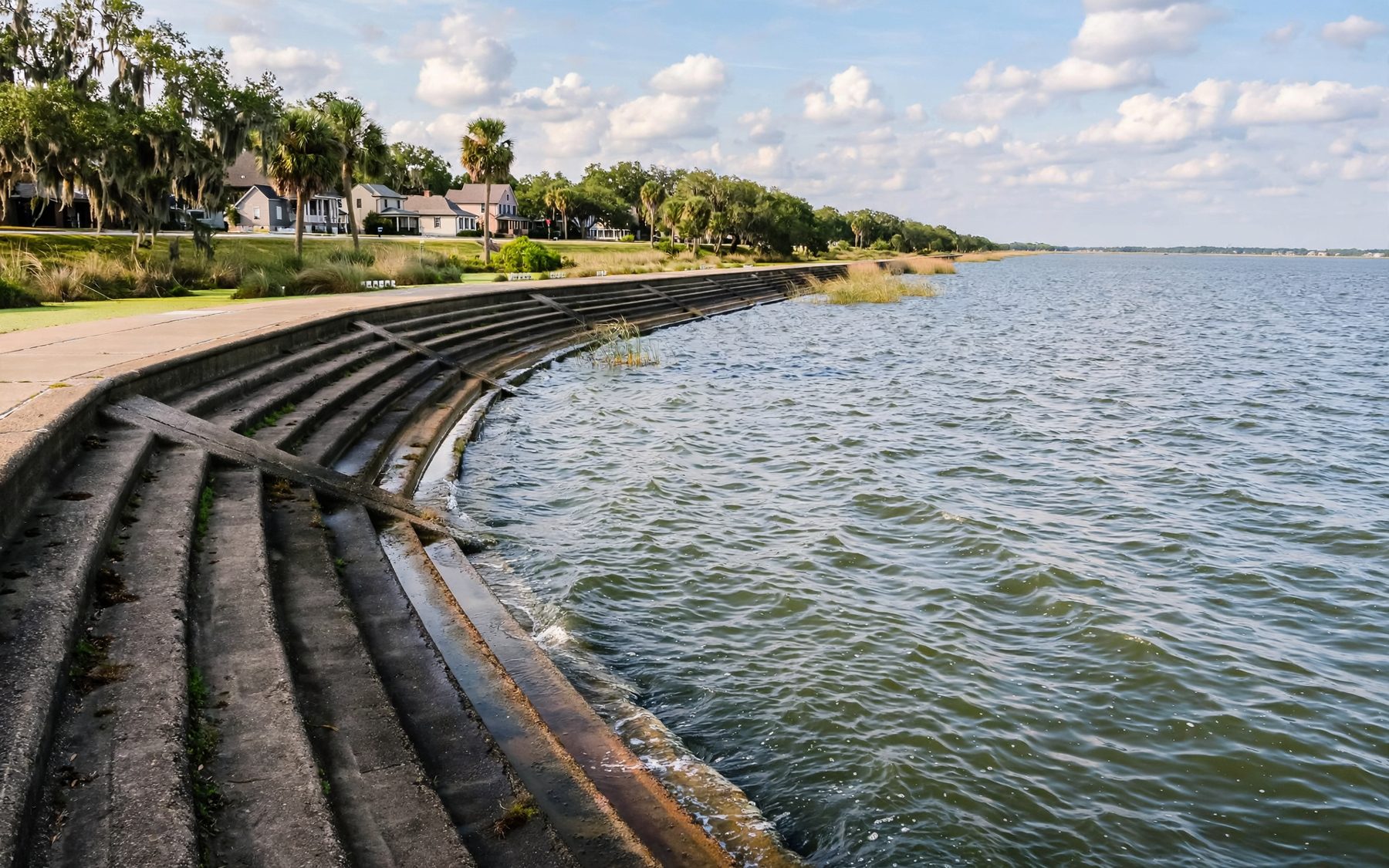
Most of New Orleans is hemmed in by levees and floodwalls, and you can spend days in the city without seeing open water. Drive or cycle north to the lake, though, and the view opens out across Lake Pontchartrain, a huge, shallow, brackish lake stretching to a distant horizon. Along its southern shore runs the lakefront, a long stepped concrete seawall with a road, lawns and parks behind it.
The seawall
The seawall was built in the 1930s as part of a large public works project that reclaimed land from the lake and created the lakefront parks and Lakeshore Drive. It runs for several miles, with broad concrete steps leading down to the water. People sit on the steps to fish, picnic, talk and watch the water. On warm evenings, the steps are lined with families and friends, and music drifts from parked cars.
The lake
Lake Pontchartrain is a large estuary connected to the Gulf of Mexico, with water that is a mix of fresh and salt. It is shallow for its size. On clear days, you can see the long, low line of the causeway bridge that crosses the lake to the north shore, one of the longest bridges over water in the world, disappearing over the horizon.
Breezes and birds
The lakefront catches breezes that the rest of the city misses, which makes it a welcome escape on a warm day. Brown pelicans, Louisiana's state bird, glide low over the water and plunge for fish. Gulls, terns and cormorants gather on posts and breakwaters. In winter, ducks raft on the lake.
When the sun drops behind the river
Facing north across the water, the seawall is not a classic sunset spot in summer, but in the cooler months the sun sets over the western lake, and the light on the water is lovely. Any evening, the sky over the lake can glow pink and orange, and the breeze makes it the coolest place in town.
Safe on the steps
The steps are concrete and can be slippery with algae near the water. Swimming in the lake is generally not advised off the seawall; conditions and water quality vary, and the steps drop off into the water. Check local guidance before entering the water anywhere. In storms, waves can wash over the steps; stay well back. The lakefront is exposed in thunderstorms, so leave when lightning approaches.
Fishing from the steps
Fishing has long been part of lakefront life. People cast from the seawall steps for speckled trout, redfish, croaker and crabs, depending on the season. Crabbing with a net and a chicken neck on a string is a classic Louisiana pastime with children. If you want to try, check the rules on licences and limits, and ask the people around you, who are usually happy to share tips.
The lakefront parks
Another panel · Bayous and the lakeBayou St. John by paddle or on footTwo to three hoursBehind the seawall, lawns and small parks run along Lakeshore Drive, with trees, picnic shelters and paths. Several points along the shore have small harbours, a marina area and a lighthouse. The lakefront is a popular place for cycling, with a long, flat route along the shore. Weekend afternoons bring families and groups; weekday mornings are quiet.
The lake and the storms
Lake Pontchartrain played a central role in the flooding of 2005, when storm surge from the lake pushed into canals and breached floodwalls, flooding much of the city. Since then, new surge barriers, gates and pumping stations have been built where the canals meet the lake. You can see some of these structures along the lakefront, a visible part of the city's flood defences.
Winter on the lake
In winter, cold fronts sweep down from the north, bringing clear skies and strong northerly winds. On those days, waves slap against the seawall steps and the lake turns steely blue. It is bracing rather than comfortable, but the clear air makes the far shore and the causeway sharp on the horizon. Wrap up, walk the seawall, and enjoy having the lakefront almost to yourself.
In spring and autumn, the lakefront is at its best: warm but not hot, with breezes, birds and long evenings on the steps.
A walk along the shore
A good way to see the lakefront is to walk or cycle a stretch of the seawall in the late afternoon, stopping on the steps whenever the light or the birds catch your eye. The path is flat and wide, with lawns behind it and the open lake in front. Families picnic under the few trees, anglers set up along the steps, and joggers pass in steady streams. As the sun drops, the water turns silver and pink, and the far shore fades into the haze.
Bring a light jacket on breezy evenings.
The road up
The lakefront is easiest to reach by car or bicycle, north from City Park or Bayou St. John. Some bus routes run near it, but service is limited. Parking along Lakeshore Drive is usually easy except on summer weekends and holidays.
Gatepost notes
- There is little shade; bring a hat and water.
- Restrooms and facilities are limited.
- Take your rubbish home; the lakefront depends on it.
- Fishing is popular; check rules and licences if you plan to fish.
For the waterway that once linked the lake to the city, see Bayou St. John. For birds across the city, read birds of the city parks, and for the river on the other side of town, the levee path.